Tokenomics
How POD captures value, rewards nodes, and aligns the network.
Revenue sources
Subscriptions
The ultimate goal of Dolphin is competing with ChatGPT, Claude & Gemini to be a household name for consumer AI usage.
Subscriptions will be available soon with different tiers of access to the services provided on the network.
Premium users will have access to:
- Web chat - higher usage limits & access to all premium models running on the network
- Discord & Telegram bot creator access - tiered based on usage allowance
- Image, Video & Audio generation plans
- Custom model creation via our Tinker style UI
Inference API
Users with credit can send requests to our API, which are randomly routed to any node running the user's chosen model.
By pooling distributed idle compute on consumer GPUs, our network can offer a cost-effective, reliable inference API. Our cost basis is significantly lower than providers running models on traditional data-center hardware, where per-generation costs are often ~10x higher than those of comparable deployments on consumer GPUs.
Compared to renting a dedicated node, API access offers both higher throughput and better cost efficiency. Inference consumers can tap into all eligible nodes for their chosen model, and they only pay for the requests they actually send. For most businesses and developers integrating AI into their workflows, this makes the API a very compelling default option.
Global AI inference market is expected to grow from ~$106B in 2025 to ~$255B by 2030.
If we take a narrow focus on AI audio generation as an example, the current leader in the space is ElevenLabs and they are bringing in >$300m in Annual Recurring Revenue.
Dolphin network can process high quality AI audio generation at a substantially lower cost than the current leaders in the space - due to the leading open-source audio models fitting perfectly on most modern consumer GPUs. This also applies to image & video generation and we believe these three modalities are the perfect fit to be powered by our global pool of idle compute.
We aim to capture a slice of the global demand for inference by competitively pricing on the back of our lower cost basis & offering an all-in-one marketplace for many popular AI models.
Value flow & token alignment
Dolphin is run as a token-only project right now.
We are looking to set up a Morpho-style shareholder-free company for purposes such as handling fiat payments to our API & subscription service + holding IP / domains on behalf of the tokenholders.
See the article below from Morpho for an explanation on how this type of structure works to protect investors in the token from a common dual structure with conflicts of interest.
Morpho shareholder-free company explanation
Users can buy credits from our API or subscribe with $POD, $ETH, $BTC, $USDC, $XMR & $ZEC.
100% of revenue buys back POD, except for payments in POD which skip that step.
We have yet to decide what ratio of POD gets routed to:
- treasury to replenish emissions that left
- staking contract as yield
This offsets selling pressure from node emissions & creates upward pressure on the price when the network is operating at net profit.
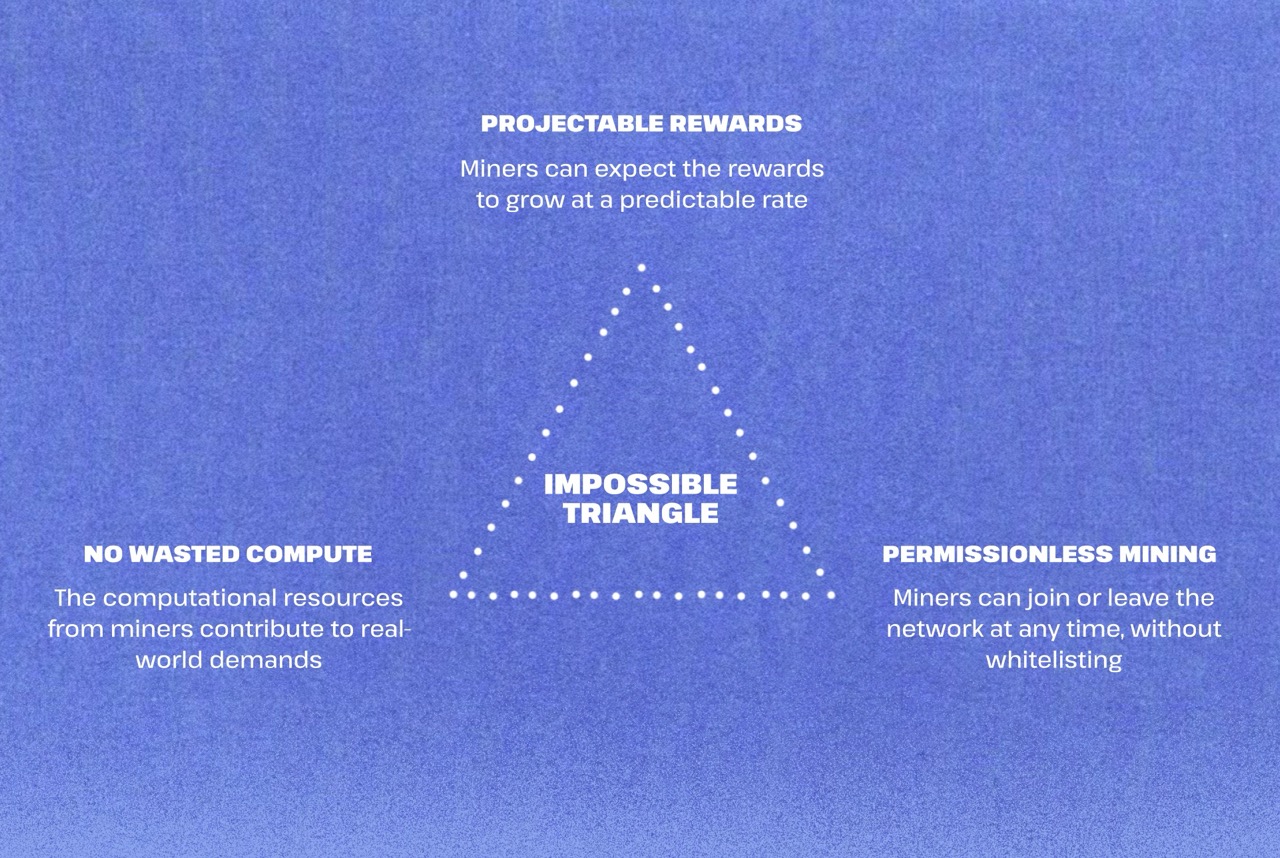
Node rewards
You can only optimize for two out of the three points in the diagram above.
We choose to remain permissionless and let rewards for each node float based on the current levels of inference demand.
Nodes earn POD tokens based on inference work completed.
If more people are using the network, utilization of each node will increase which naturally incentivises more supply to come online (with a bit of a delay).
We like this because the node count grows naturally with demand, compared to other networks that overly incentivise the supply side with predictable rewards – resulting in a vast network of mostly idle compute & heavy token emissions.
Node operators earn emissions from treasury based on inference tokens processed.
Currently on datagen.dphn.ai we pay $0.5 per 1m tokens worth of POD in emissions.
In prod, we may set pricing so that protocol revenue targets net buy pressure, or set pricing lower than emissions so that we subsidise growth with emissions.
Peer-to-Pool economic design
The peer-to-pool design is different to some other peer-to-peer networks that link buyers of compute into a "session" with a node for X period of time, and settle on-chain at the end.
On the demand side, API users buy credit from the protocol by depositing tokens to a smart contract. Their requests get sent to any node on the network depending on what is currently available.
On the supply side, nodes running the same model form a 'pool' that processes requests sent to that model. Nodes are assigned jobs based on availability and performance, and no direct link between the request sender and node provider is made. Nodes are rewarded for their contributions with POD tokens from the node rewards pool.
The decoupling of the buy and sell sides of the network means that more or less POD can be distributed to nodes than what is received from revenue.
This allows the network to initially operate at a net loss to grow the number of available nodes and offer larger amounts of free inference until the network stabilizes around a natural equilibrium of inference demand and node supply.
The network is designed to have protocol revenue outpace emissions when nodes are close to full utilization, which would mean that the network is operating at a profit resulting in net positive buy pressure on POD.
Token design
Our token design is inspired by the best parts of other projects that we found to compliment our distributed inference & training network:
- ETH style slashable bond deposits for node operators & validators
- CRV style reward boosting for node operators (up to 1.3x boost for bonding staked POD - up to 1.2x is linear with 3 months of bond, and 1.2x to 1.3x is competitive based on what other node operators are doing plus an absolute 6 month bond requirement for the max boost)
- xSUSHI / yCRV / yYFI style auto-compounding staking, no need to claim rewards means that staked POD can be deposited as a bond to boost node rewards. Tax efficient as no claims have to be made and all appreciation is in the staked POD position
- stAAVE style 3 month cooldown windows for staking & bonding + stAAVE & vlCVX constant non-decaying rewards
POD can be staked into a transferable auto-compounding vault similar to xSUSHI / yCRV / yYFI.
Staked POD wallet balance stays the same as rewards are distributed - the redemption ratio increases as POD rewards are sent to the contract.
eg. Stake 10 POD on day one. We add 10% dividend. Redemption ratio is now 1.1. Withdraw your staked position - receive 11 POD.
Staked POD is for investors or inference users who receive:
- A portion or all of network revenue, in POD (auto-compounding balance)
- Access to different levels of product subscriptions without having to pay directly
- Daily free inference allowance
Staked POD has a delegation function for both governance & daily inference allocations.
Meaning that we could have a CRV / CVX style votemarket where people bid to receive delegations from stakers who don't use their daily inference.
Extra yield for stakers who don't use their allocation & cheap inference below the market rate for those who bid for delegations.
vlCVX "constant power" refers to the mechanism within Convex Finance where the voting power & staking APY derived from locking CVX tokens for 16 weeks (vlCVX) remains constant throughout that lock-up period, unlike Curve Finance / other veTokens where voting power decays over time and it forces you to perpetually re-lock with capital becoming a sunk cost.
Many consider this an improvement over veTokenomics as the asset is more attractive to buy & stake.
This takes the benefits of vlCVX (consistent full APY without having to re-lock to maintain 100% of rewards) while having users stay constantly staked by default instead of all stakers becoming unlocked every 16 weeks.
Bonding & node reward multiplier
Our node bonding contract takes staked POD as deposit - this becomes bonded POD.
Bonded POD is non-transferable with slashing / freeze & some other features.
Node operators that are bonded can be slashed if they are caught doing anything malicious such as trying to cheat by modifying the node software or model that is being run.
Hot wallets on validator nodes can freeze bonds if they detect model mismatch - this disables exit during the 3 month cooldown, and can be cancelled if a false flag.
Multisig can slash or unlock these frozen wallets upon review - this process can be automated further in the future.
The POD reward multiplier determines how much additional yield an operator earns on top of their base node rewards. It is inspired by Curve's LP boost mechanism, but adapted for a decentralized AI network with usage-based rewards, account-wide bonding, epoch-based accounting, and slashable operator bonds.
At a high level:
- Nodes earn base rewards from completed inference, validation, and related protocol work.
- Accounts that bond staked POD receive a multiplier on eligible node rewards owned by that account.
- Boosts activate only for registered, unsuspended accounts with enough recorded earnings history and at least roughly $5 of total lifetime base earnings at launch. This is implemented as a governance-set POD threshold, not as a live USD oracle and not as a $5/day requirement.
- The earnings denominator is based on a trailing multi-epoch average of base rewards, then updated with asymmetric smoothing: it rises quickly when activity increases, but falls slowly when activity decreases.
- Reward multipliers are computed only at epoch boundaries and then frozen for the next reward epoch. Reward workers use the frozen account snapshot instead of recalculating from live state.
- Bonding the equivalent of 3 months of earnings (13 weeks) gives a linear pathway up to a 1.2× multiplier on boostable rewards once the account is boost-eligible.
- The maximum multiplier is 1.3×. The pathway from 1.2× to 1.3× is competitive, based on relative over-bonding versus other operators, and also requires at least 6 months of earnings bonded as an absolute requirement for the max boost.
- Accounts that maintain at least ~3 months of earnings bonded (13 weeks) can become validator-eligible. Validators check the logprobs of other nodes to detect and report deviations from the expected model fingerprint. Eligibility uses persistent epoch-based hysteresis to prevent flapping.
- Providers exclusively earn bonded POD for the first month of operation so that all nodes have a strong economic incentive not to cheat.
- Node providers have two options when claiming their weekly rewards from the contract: claim as bonded POD as the standard option, or claim as liquid POD with a 20% fee that goes directly to stakers by being sent to the staking contract.
- Until an operator has 4 weeks worth of their expected earnings as bond, they can only claim bonded POD. After this point, they can choose between both options.
- Bonds that activate the cooldown timer lose boost + the ability to claim liquid POD & validator status.
All calculations are done in POD units only, without any price oracle inside the reward engine. The bond is per account (wallet), and the resulting multiplier applies across all nodes owned by that account. Adding more nodes increases the account's base earnings and therefore requires proportionally more active bond to maintain the same weeks-bonded ratio.
Token allocation
Total supply: 500,000,000 POD
| Allocation | Tokens | Percentage |
|---|---|---|
| Treasury | 184,122,686 | 36.82% |
| Team | 155,511,733 | 31.10% |
| Seed | 117,600,000 | 23.52% |
| Uniswap v4 pool | 42,765,581 | 8.55% |
Seed round and treasury
Our seed round was $886,000 on 20th June 2024 for 117,600,000 tokens with 1 year cliff vesting.
All seed tokens are fully unlocked.
As of 1st May 2026, seed investors are still holding 67.4m POD in total, equal to 13.49% of total supply and 57.36% of the seed allocation.
Of this, 15.5m POD is liquid and 51.9m POD is staked.
The team bought back 38m POD from seed investors at $0.01 during Q1 2026.
The treasury tokens & LP is held in a 3/4 Gnosis Safe multisig.
Treasury tokens will only be used for node emissions or future fundraising.
Node emissions are paid solely based on how much inference is processed by node operators.
This avoids over incentivising supply in the absence of demand.
Team tokens are not fully distributed yet. All core team members will be vested for a minimum 2 year cliff + 5 years linear starting from June 2026.
4.25m tokens were also sold otc across 3 deals in 2025.
1 year cliff + 2 year linear vesting was applied to these sales - all of them were sent as staked tokens.
Exit queue
Right now staking and bonding both have a 3 month stAAVE style cooldown period - with a 1 week withdraw window to claim at the end.
Bonding withdrawals can exit directly to POD, as the bonding contract is whitelisted to bypass a double cooldown.
The exit-queue from these contracts can be watched live at https://exitqueue.dphn.ai.